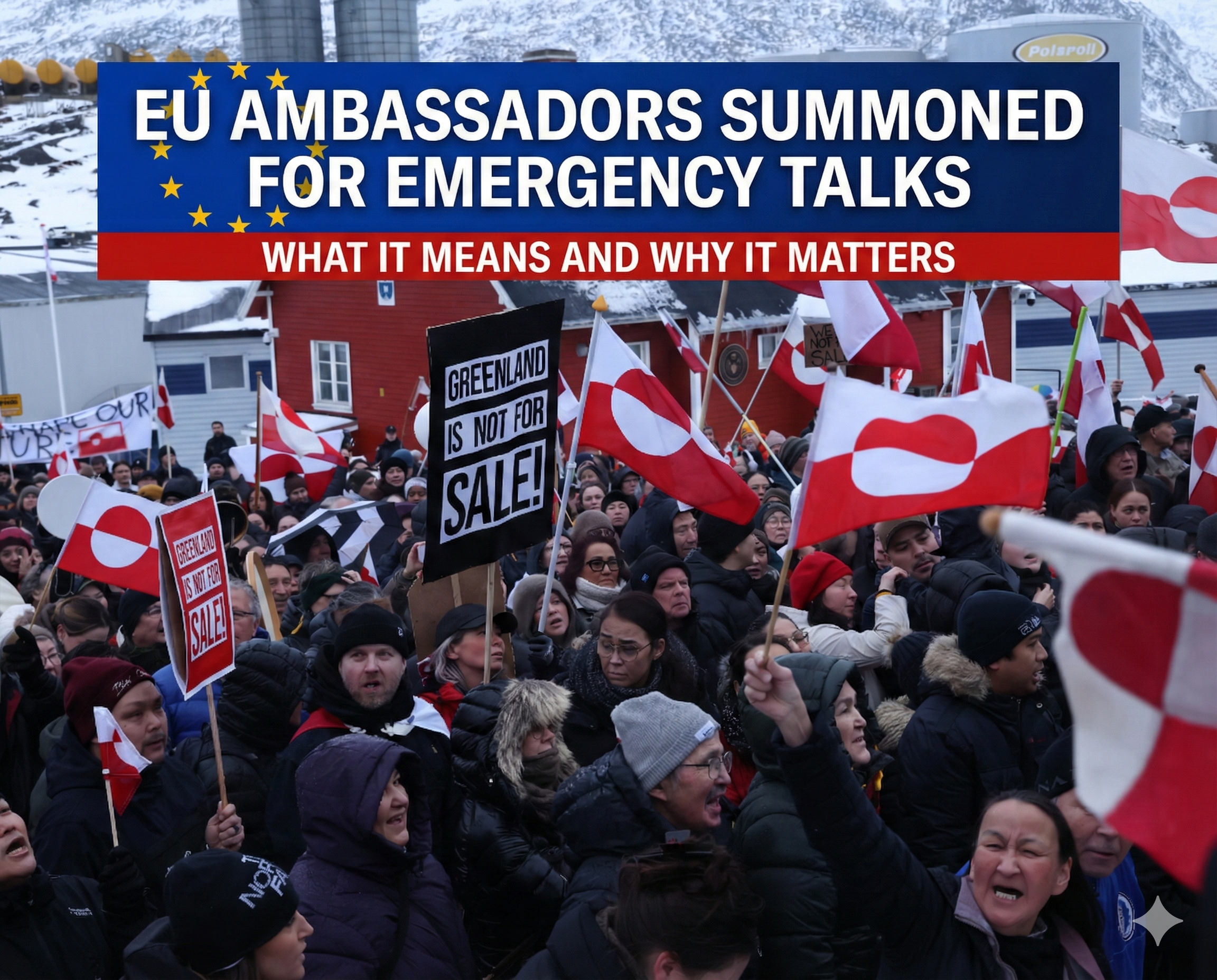

When we see headlines that EU ambassadors have been summoned for emergency talks, we’re not looking at routine Brussels choreography. We’re watching the European Union shift into crisis mode. In this piece, we unpack what usually triggers such urgent meetings, how they’re organized behind the scenes, which issues race to the top of the agenda, how different capitals react, and what concrete decisions these talks can set in motion, so we can read the news with a lot more context, and a lot less guesswork.
What Triggered The Emergency Summoning Of EU Ambassadors
When EU ambassadors are called in urgently, it almost always means one thing: something significant has changed in Europe’s security, political, or economic environment, and leaving it to the normal meeting schedule would be too slow.
Because we don’t have live access to today’s confidential diplomatic cables, we can’t say which exact incident is driving the latest emergency talks. But we can map the typical patterns that have triggered such summits in recent years.
The Timeline Of Events Leading Up To The Meeting
In most modern cases, the sequence looks roughly like this:
- Initial shock event
A surprise development hits: a sudden military escalation, a major terrorist attack, a large cyber‑incident, a forced change of borders, or a dramatic political move by a major power.
- Major EU emergency meetings have previously been called within hours of events like Russia’s full‑scale invasion of Ukraine in February 2022 and the Hamas attacks on Israel in October 2023.
- Foreign ministries immediately start internal assessments and crisis calls.
- Coordinated alert among EU institutions
The European External Action Service (EEAS) in Brussels, led by the EU High Representative for Foreign Affairs and Security Policy, collects information from EU delegations and national missions.
- Secure channels are used to share preliminary situation reports with capitals.
- Informal calls among key ambassadors and political directors test whether there’s consensus to escalate to a formal emergency consultation.
- Decision to summon ambassadors
Once a critical mass of member states and the EEAS agree that existing decisions or mandates may be outdated, the chair (often the rotating Council Presidency) moves to convene ambassadors.
- The EU can bring ambassadors together in Brussels on very short notice, often within the same day if they are already in town, or within 24 hours if they must travel.
- Agenda setting just before the meeting
Draft agendas, options papers and legal notes are circulated. Capitals send last‑minute instructions to their ambassadors, sometimes changing positions hours before the meeting if domestic politics shift.
Who Called The Emergency Talks And How The Process Works
Formally, emergency ambassadorial meetings around foreign and security policy are usually held in the Political and Security Committee (PSC), which is made up of the 27 member states’ ambassadors dealing with security matters.
Here’s how the summoning mechanism generally works:
- Who can trigger it?
- The rotating presidency of the Council of the EU (held for six months by one member state at a time).
- The High Representative for Foreign Affairs and Security Policy.
- A group of member states pushing through the Council structures, especially if they share a border with the crisis.
- Legal basis and flexibility
- The PSC’s role is set out in the Treaty on European Union and Council decisions.
- The rules deliberately allow the PSC to meet “whenever necessary,” which is why emergency convocations are legally straightforward and can be done in hours, not days.
- Where and how they meet
- Almost always in Brussels, inside secure Council facilities.
- Sometimes in hybrid form, with a few ambassadors connected remotely if they’re travelling with their ministers.
Behind the scenes, this looks less glamorous than it sounds: long paper briefings, last‑minute phone calls with home capitals, and stiff schedules for back‑to‑back consultations with other EU bodies.
Related Post: economic growth
How EU Emergency Diplomatic Consultations Work
When we read that EU ambassadors are in emergency talks, we’re essentially watching the EU’s top diplomatic and security coordination body in action.
The Role Of EU Ambassadors In Crisis Moments
EU ambassadors are not just ceremonial figures. In these settings, they’re our countries’ political operators and first responders at the diplomatic level.
Their main crisis‑time roles include:
- Rapid information fusion
- They bring in intelligence, military, and political assessments from their capitals.
- Ambassadors often work from classified briefs prepared overnight by defense, intelligence, and foreign‑policy units back home.
- Position‑building for ministers
- They hammer out the contours of a common EU line so that foreign ministers, defense ministers, or leaders can adopt decisions quickly.
- Ambassadors negotiate language for statements, sanctions packages, support missions, or travel advisories.
- Crisis management and de‑escalation
- They coordinate messages to external actors, whether to warn, reassure, or propose mediation.
- They also weigh legal risks, escalation dynamics, and humanitarian fallout.
In practice, if leaders later stand together at a press conference, it’s usually because ambassadors and senior officials first spent hours or days thrashing out an agreed line.
Formal Mechanisms For Urgent Coordination Inside The EU
Several EU bodies can be pulled into emergency mode at once. The PSC and ambassadors sit at the center of a web of institutions that can move surprisingly fast when needed.
Key mechanisms include:
- Political and Security Committee (PSC)
- The primary venue for emergency ambassadorial talks on foreign, security and defense issues.
- The PSC can recommend sanctions, civilian missions, military training operations, and crisis statements, which are then endorsed by the Council.
- COREPER (Permanent Representatives Committee)
- All‑purpose body of EU ambassadors that handles nearly all Council business.
- In a non‑security crisis (for example, a sudden economic shock), emergency COREPER meetings can be called to fast‑track legislation or financial support.
- Integrated Political Crisis Response (IPCR) arrangements
- A dedicated framework for cross‑sectoral crises such as pandemics, hybrid attacks, or massive migration flows.
- Can be activated in “information‑sharing” or “full activation” modes, depending on severity.
- Coordination with the European Commission and the European Council
- The Commission provides analysis on trade, energy, finance, and legal implications.
- The President of the European Council coordinates leaders’ summits, sometimes convening video conferences in parallel with ambassador meetings.
When everything works, we see a chain: ambassadors assess, recommend, and draft: ministers and leaders decide: EU institutions carry out. When it doesn’t, we see leaks, disunity, and delayed responses in the headlines.
Key Issues Likely Dominating The Agenda
The phrase “emergency talks” is vague, so it’s useful to break down what almost always lands on the table when EU ambassadors gather under that label.
Security, Defense, And Geopolitical Flashpoints
The most common triggers are security shocks and geopolitical escalations. Typical questions on the table include:
- Is there a direct threat to EU territory or citizens?
- If EU citizens are killed or targeted abroad, emergency ambassador meetings are almost automatic.
- Ambassadors review evacuation options, consular coordination, and potential joint statements.
- Do we need a coordinated military or security posture?
- Requests for airspace patrols, naval deployments, or reinforcement of EU missions near a conflict zone.
- Adjustments to support for partners under attack, such as increased arms deliveries or training, as seen with Ukraine since 2022.
- How do we position ourselves geopolitically?
- Aligning with NATO, the G7, or the UN Security Council.
- Managing relations with great powers like the United States, China, and Russia considering the new crisis.
Economic And Energy Risks Under Discussion
Crises rarely stay confined to the security realm. Economic and energy vulnerabilities are now built into every emergency agenda.
Ambassadors tend to focus on:
- Sanctions and counter‑sanctions risks
- What new restrictive measures could be imposed quickly, and what blowback to expect.
- Since 2014, and especially after 2022, the EU has used sanctions as a primary foreign‑policy tool, so emergency meetings often include technical annexes listing individuals, banks, or companies.
- Energy security and price shocks
- Whether key gas or oil pipeline routes are threatened.
- The impact of any disruption on already tight energy markets, especially in winter.
- Coordination on strategic reserves and alternative suppliers.
- Financial stability and trade impacts
- Risks to EU banks exposed to the affected region.
- Disruptions to critical supply chains, from food to microchips.
Humanitarian, Migration, And Legal Dimensions
No modern EU emergency discussion is complete without the humanitarian and legal angles.
Ambassadors often must weigh:
- Expected displacement and migration pressure
- Major conflicts on or near the EU’s borders have repeatedly produced sudden inflows of refugees, which member states must prepare for in real time.
- Negotiations about temporary protection measures, relocation schemes, and support for frontline states.
- Humanitarian aid and access
- Rapid release of EU civil‑protection or humanitarian funds.
- Pressure on parties to the conflict to allow aid corridors.
- International law and accountability
- Whether alleged war crimes or violations of international humanitarian law are occurring.
- Options for supporting investigations by the International Criminal Court or UN mechanisms.
By the time leaders speak, most of these heavy trade‑offs, security, energy, humanitarian, legal, have already been mapped out in these ambassadorial rooms.
Reactions Across European Capitals And Beyond
Emergency talks among EU ambassadors don’t take place in a vacuum. Capitals watch each other closely, and outside powers read every nuance of EU language.
Differences In Tone Among Member States
We rarely see unanimous instincts from all 27 countries at the outset.
Patterns we’ve seen in past crises include:
- Frontline vs. distant states
- Countries geographically close to the crisis often push for faster, harder measures, sanctions, deployments, or robust statements.
- Others prioritize de‑escalation, mediation, or economic caution.
- Historical and political sensitivities
- States with particular historical experiences, occupation, civil war, energy dependence, tend to read risks differently.
- These differences don’t disappear in emergencies: they show up in wording battles over single verbs and adjectives in EU statements.
- Domestic politics
- Governments facing elections, fragile coalitions, or strong opposition parties may be more cautious about measures with domestic costs.
Ambassadors have to navigate these divides, translating red lines from home into compromises in Brussels.
Signals From Non‑EU Powers And International Organizations
How non‑EU actors react can either strengthen or complicate the EU’s hand.
Typical external signals ambassadors track include:
- United States and NATO
- Statements or deployments from Washington and NATO Headquarters in Brussels.
- If NATO raises alert levels or moves assets, EU ambassadors must immediately factor that into their risk calculus.
- United Nations and regional organizations
- UN Security Council sessions, draft resolutions, and statements by the Secretary‑General.
- Positions of organizations such as the OSCE, Council of Europe, African Union, or Arab League, when relevant.
- Major non‑Western powers
- Messaging from China, India, Gulf states, or others that might shape diplomatic coalitions.
- Signals about energy supplies, arms sales, or mediation offers.
For us as news readers, watching these parallel reactions helps us gauge whether the EU is operating in a favorable international environment, or swimming against the tide.
What The Emergency Talks Could Lead To Next
When EU ambassadors are summoned like this, the end goal isn’t just another communiqué. It’s to set real decisions in motion, quickly.
Possible Diplomatic, Economic, And Security Responses
Outcomes vary widely from one crisis to another, but the menu of options is relatively consistent.
Diplomatic steps may include:
- Joint EU statements and démarches delivered in third countries’ capitals.
- Coordinated recalls of ambassadors for consultations.
- Offers of mediation, monitoring missions, or participation in international contact groups.
Economic and legal measures typically revolve around:
- Targeted sanctions on individuals and entities linked to the crisis.
- Sectoral sanctions on finance, energy, technology, or transport.
- Trade re‑routing, export controls, or suspension of cooperation agreements.
Security and defense responses can involve:
- Reinforcing EU or national missions on the ground.
- Coordinated arms deliveries or training for a partner under attack, where politically agreed.
- Cyber‑defense assistance and help countering disinformation campaigns.
Crucially, ambassadors don’t carry out these steps themselves: they design and recommend them, so ministers and leaders can move fast with broad backing.
Below are some of the most common questions that come up whenever we face headlines about emergency EU talks, with indicative timeframes based on past practice:
- How quickly can EU ambassadors meet after a crisis?
In acute shocks, they can convene in Brussels within 6–24 hours once the chair decides.
- How long until we see a first official EU reaction?
Often within the same day, especially via social media or a short statement from the High Representative, followed by a more detailed text in 24–48 hours.
- How long does it take to agree sanctions?
For urgent, politically uncontroversial listings, decisions can come in a few days. Complex, large‑scale sanctions packages have historically taken 1–3 weeks from initial proposal to legal adoption.
- When do leaders get involved?
If the crisis is severe or prolonged, we often see an extraordinary leaders’ video conference or summit within several days to two weeks, depending on availability and the need to prepare substantial decisions.
Implications For EU Unity And Future Policy
Emergency ambassador meetings don’t just manage the crisis of the day: they reshape EU policy over time.
We should watch for three things after such talks:
- Depth of unity
- Are statements unanimous and concrete, or vague and hedged?
- The more detailed and operational the outcome, the more we can infer that EU capitals are genuinely aligned.
- New precedents
- Sanctions or missions launched today often become templates for the next crisis.
- Emergency decisions on energy diversification, defense spending, or migration management can lock in long‑term shifts.
- Institutional learning
- Each emergency stress‑tests EU systems: secure communications, decision speeds, legal toolkits.
- Post‑crisis reviews often lead to new mechanisms or reforms, tighter coordination with NATO, stronger resilience policies, or faster crisis funds.
In that sense, the headline about “EU ambassadors summoned for emergency talks” is really shorthand for something bigger: another round in the long process of turning a union of 27 states into a more agile geopolitical actor.
Conclusion
The next time we see that EU ambassadors have been summoned for emergency talks, we’ll know we’re looking at the EU’s crisis brain at work, not just another Brussels meeting.
An emergency convocation tells us that events have outpaced existing policies and that the 27 governments need a rapid, coordinated reset of their diplomatic, economic, and security posture.
By understanding who calls these meetings, how the machinery functions, what’s on the agenda, and how quickly consequences can follow, from sanctions to humanitarian aid, we put ourselves in a far better position to read between the headlines.
For us as news readers, the key is to watch three signals in the hours and days after such a headline breaks: how fast EU ambassadors meet, how united their first outputs look, and how closely those outputs align with parallel moves by NATO, the G7, and the UN. That’s where the real story of Europe’s response, and its future direction, quietly takes shape.
Frequently Asked Questions
What does it mean when EU ambassadors are summoned for emergency talks?
When EU ambassadors are summoned for emergency talks, it signals the EU has entered crisis mode. A serious security, political, or economic shock has outpaced existing policies, so ambassadors meet urgently in Brussels to fuse information, coordinate positions, and prepare rapid decisions for ministers and leaders.
What typically triggers EU ambassadors to hold emergency consultations?
Emergency consultations are usually triggered by sudden shocks: major military escalations, terrorist attacks, cyber incidents, border changes, or dramatic moves by big powers. These events can directly affect EU security, energy supplies, the economy, or citizens abroad, making it too risky to wait for normal meeting schedules.
How quickly can the EU react after its ambassadors are summoned for emergency talks?
In acute crises, EU ambassadors can meet within 6–24 hours once the chair decides. A first official reaction often follows the same day via a short statement, with more detailed positions, potential sanctions options, and humanitarian or security measures emerging over the next 24–72 hours.
What outcomes can come from EU emergency talks on foreign and security policy?
Emergency talks can lead to joint EU statements, coordinated diplomatic démarches, targeted or sectoral sanctions, adjustments to military or civilian missions, and plans for humanitarian aid or refugee management. Ambassadors design these options, which are then formally adopted and implemented by ministers, leaders, and EU institutions.
How do EU emergency talks compare with NATO or UN crisis responses?
EU emergency talks focus on sanctions, economic tools, diplomacy, and internal coordination, while NATO is a defense alliance centered on military posture and deterrence. The UN provides a global forum and legal framework. In major crises, EU positions are usually